












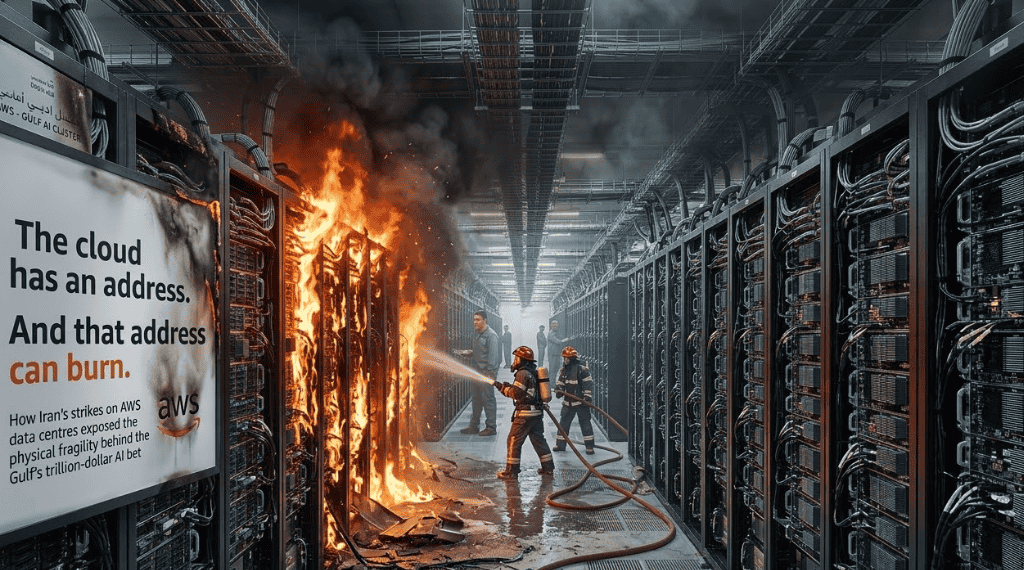
The Middle East’s AI infrastructure boom has hit its first major crisis, as physical attacks on cloud facilities expose the vulnerabilities at the heart of the global digital economy
For years, tech giants were told the same story: come to the Gulf, bring your data, your models, and your chips, and in return you will get stability, sovereign wealth funding, and some of the cheapest energy on the planet. On 1 March 2026, that story ended in fire.
Iranian drone strikes hit three Amazon Web Services (AWS) data centres in the region, two in the UAE and one in Bahrain, in what experts are calling the first confirmed military attack on a hyperscale cloud provider in history. The strikes knocked two of the three availability zones in AWS’s UAE region offline and triggered outages across core services including EC2, S3, and DynamoDB.
The real-world impact was felt immediately. Consumer apps including delivery and taxi platform Careem, payments companies Alaan and Hubpay, and major UAE banks including Emirates NBD and ADCB all reported service disruptions. AWS advised customers to migrate their workloads to alternative regions and warned that recovery would be prolonged given the extent of the physical damage.
A Strategic Target, Not a Coincidence
Iran’s Islamic Revolutionary Guard Corps made no attempt to disguise its intent, claiming responsibility and stating the strikes were aimed at identifying the role of these centres in supporting enemy military and intelligence activities.
The targeting logic reflects how dramatically the strategic calculus around data infrastructure has shifted. Iran and its proxies have historically targeted oil fields, but their attacks on UAE data centres signal that cloud infrastructure is now considered equally critical, according to Patrick Murphy, executive director of the geopolitical unit at advisory firm Hilco Global.
The blurred line between commercial and military use has made the situation more complex. The US military uses AWS to run some of its workloads, and Iran’s Fars News Agency stated the Bahrain facility was deliberately targeted for its role in supporting enemy military and intelligence activities. AWS declined to comment on the claim.
Billions at Stake
The timing could not be worse for the Gulf’s AI ambitions. Oracle, Nvidia, and Cisco are all involved in OpenAI’s AI campus in the UAE, dubbed Stargate, which in collaboration with Emirati firm G42 will span 10 square miles and include a 5-gigawatt capacity. Microsoft has also committed $15 billion into the UAE by 2029.
Before the attacks, the UAE’s data centre market was expected to more than double in value from $3.29 billion in 2026 to an estimated $7.7 billion by 2031. That trajectory is now uncertain. Experts warn the attacks put into jeopardy the cloud and AI strategies of the Gulf economy, as investment in data centres is designed with a very long time frame and any geopolitical disruption significantly increases the associated risk.
Will Hyperscalers Leave?
The short answer is: not yet. Given the huge costs already invested in operational facilities, alongside power contracts, land agreements, and fibre connectivity, it is unlikely AI hyperscalers will look to relocate existing capacity. Relocating or closing facilities could lead to service-level agreement breaches and significant reputational risk.
However, future investment is a different matter. Iran has now listed assets of companies including Amazon, Microsoft, Google, Oracle, Nvidia, IBM, and Palantir across roughly 30 locations throughout the Middle East as potential targets, describing these sites as enemy technology infrastructure.
The attacks have also forced a rethink on resilience. Companies will need to diversify data storage, with cloud providers expected to commit to multi-region replication and backup options. There is also growing pressure to classify data centres formally within national security planning frameworks, alongside energy facilities and telecommunications networks.
The security frameworks underpinning the US-UAE AI partnership were built for supply chain control and political alignment, not for protecting buildings during a military attack. That gap is now impossible to ignore.
The cloud has always been a physical thing. The Middle East conflict has simply made that impossible to forget.