











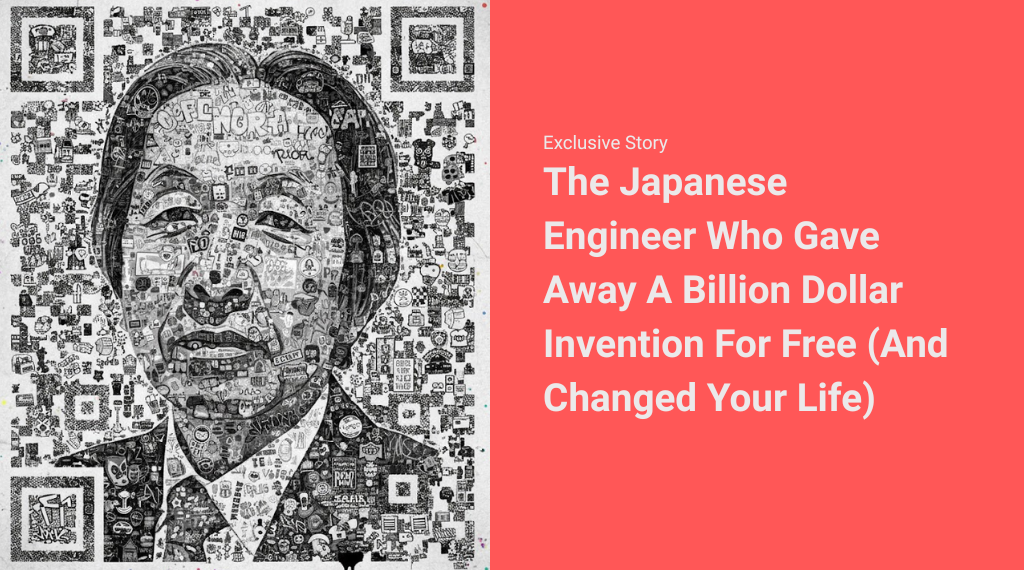
Every day, 2 billion QR code scans happen on Earth!!
BILLION.
You scan them for menus. Payments. Boarding passes. You don’t think twice.
But the inventor? He never wanted YOU to touch them. He built them for car factories. That’s it.
This is the story of how a lunch break changed the world.
1992: Toyota Has a Barcode Problem
Japan’s economy just crashed. Companies are panicking. DENSO, a car parts maker, needs to survive.
They hand engineer Masahiro Hara a problem.
Toyota factory workers are drowning. They scan 1,000 barcodes per day. Each barcode holds 20 characters. That’s barely enough for “Toyota Part Model X.”
Oil smudge? Unreadable. Weird angle? Unreadable. Bad day? Too bad. Keep scanning.
The workers are miserable.
The Game That Sparked Everything
Hara tries fixing the scanners. Doesn’t work. The problem isn’t the reader. It’s the barcode itself.
One dimensional. Linear. Pathetic.
Then lunch happens.
Hara’s playing Go. That ancient Japanese board game with black and white stones. He stares at the board.
Black. White. Patterns everywhere.
Lightning strikes his brain.
“What if information could flow in TWO directions?”
Barcodes only go horizontal. One dimension. But what if data could go horizontal AND vertical? Two dimensions means exponentially more space.
Game changer.
Six Months of Obsession
Now Hara faces a new problem.
Scanners need to recognize QR codes instantly. Any angle. Upside down. On a fast moving conveyor belt. No hesitation.
His solution? Put special patterns in three corners. Those square-within-square “eyes” you see on every QR code.
But wait. What if the scanner sees a random design on a cardboard box and thinks it’s a QR code?
He needs a pattern that basically NEVER exists in real life.
So Hara does something insane.
He spends six months examining every piece of printed matter he can find.
Newspapers. Magazines. Flyers. Boxes. Cereal packaging. Probably toilet paper wrappers too.
He’s hunting for the ratio of black to white that appears the LEAST in everyday printing.
After months of this madness, he finds it.
1:1:3:1:1
That ratio became the DNA of every QR code ever created. It’s why your phone spots them instantly in cluttered chaos.
1994: The Invention Nobody Wanted
End of 1993. Hara presents his “Quick Response Code” to management.
Their response? Crickets.
“Too revolutionary.” Translation: “This is weird and we’re scared.”
But Hara believes. So he goes straight to customers. Car manufacturers drowning in barcode hell.
They get it immediately.
The QR code holds 7,089 characters. That’s 350 TIMES more than a traditional barcode.
It handles Japanese Kanji. Scans from any angle. Still works if 30% is damaged or dirty.
The automotive industry explodes with adoption.
The Decision That Changed Everything
Here’s where DENSO makes the craziest choice in business history.
They own the patents. They could charge royalties. They could make BILLIONS.
Instead?
They make it FREE.
Forever.
For everyone.
Why? Because Hara wants the technology to spread. For QR codes to work, other companies need to build infrastructure. Scanners. Readers. Software.
If it’s locked behind patents, nobody bothers.
So they open it up completely.
By 2002, every industry in Japan uses QR codes. Retail. Medical. Food. Logistics. Government betting systems. During mad cow disease, supermarkets use them to trace meat.
The Twist Nobody Saw Coming
For 15 years, QR codes live quietly in factories and warehouses.
Hara thinks that’s their destiny.
Then smartphones happen.
Suddenly everyone has a camera in their pocket. Apps emerge that read QR codes.
In China, WeChat and Alipay turn them into payment systems. Over 2 billion transactions DAILY.
Hara admits: “I never expected general users would use it. Especially as a payment method. It was completely unexpected.”
He invented something for car parts.
He accidentally revolutionized human civilization.
Where They Live Now
QR codes are everywhere doing things Hara never imagined.
Ancient Japanese shrines use them for digital fortunes.
COVID contact tracing saved millions of lives.
Contactless menus killed laminated plastic forever.
Electronic boarding passes murdered the paper ticket industry.
Cryptocurrency wallets for Bitcoin transfers.
Gravestones with codes linking to memorial websites. Yes. Really.
Fashion shows embed them in clothing.
Museum exhibits offer audio guides.
Dating apps use them for quick profile sharing.
The Man Who Reads Them With His Eyes
Masahiro Hara is 64 now. Still works at DENSO WAVE.
He claims he can decode QR codes manually. Using just paper and pencil.
No scanner needed.
The man understands his creation so deeply he doesn’t need technology to read it.
He’s also ridiculously humble. Keeps saying things like “I just wanted to solve the factory problem” and “I never thought it would leave the automotive industry.”
His current dream? Colored QR codes storing short videos viewable within the code itself.
Because apparently revolutionizing humanity once wasn’t enough.
Next Time You Scan
Think about this.
That pixelated square was born because factory workers were tired.
Shaped by a lunch game of Go.
Perfected through six months of obsessive material examination.
Released free so everyone could benefit.
Never meant for you.
But somehow became yours anyway.
Masahiro Hara wanted efficient car factories.
Instead he gave the world a universal language between physical and digital realms.
The most beautifully chaotic invention story ever.
Share this if you scanned a QR code today. You probably did.
Want more stories about tech that accidentally changed everything? Follow Appedus for the weird, wonderful, and “wait WHAT” stories behind your daily digital life.